
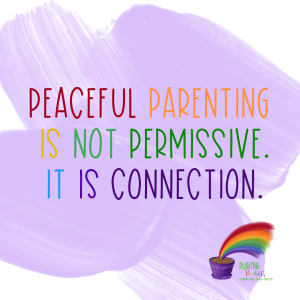
Peaceful Parenting is not permissive, it might appear that way to the outsider because we don’t yell at our kids or punish them or shame them. We don’t engage in these things which are often perceived as discipline and teaching. Instead we co-regulate with them, we help them name their feelings and needs and see other people’s feelings and needs, we connect with them with empathy and compassion. Then when all of that is achieved we can discipline which means to teach. We do this in equity and harmony when they are in a space for learning and growth. This is raising elders.
Peaceful Parenting is harmony, healthy, hopeful.
Peaceful parenting is not permissive, not punishing, not lazy.
One of the biggest concerns I hear from parents is, “I would like to try peaceful parenting, but when I see people using it it just seems like they let their kids get away with anything.” Ooof, that is an all too common myth that we are going to unpack today.
Peaceful parenting is a philosophy, practice, and lifestyle that upholds the values of equity, empathy, compassion, and the root of the word discipline. Discipline comes from the Latin word “disciple” which means student or one who studies. In peaceful parenting discipline is seen as teaching, guiding children into growth, holding space for learning. To choose one or two words and say, “This is the key to peaceful parenting” is a real challenge because all of these components are indeed critical. But naming the results of peaceful parenting in just two words? That we can do: connection and harmony.
So how do we get there? We start with equity. For generations we have held children in lower regard from the adults in their lives. “Children should be seen and not heard,” “Be careful you don’t spoil the child, they will manipulate you,” and even “Sometimes we just have to get their attention and that means yelling or spanking.” We often expect children to behave like miniature adults: sharing, caring, being gentle, listening to others, staying patient, and controlling their feelings (especially their feeling of anger).
Except, we their adults, often struggle with those same behaviors. How often do we “lose our cool” and yell at our kids? How often do we feel frustrated when our kids want to borrow our phones? How often do we listen with one ear open, one eye on a device, and half our mind on the agenda for tomorrow? No one can be the “perfect well behaved adult” all the time. Fortunately, being perfect is never our goal because we are human beings AND our children deserve the same grace and compassion we hopefully extend to ourselves.
Children’s brains are not developed enough to behave like miniature adults. Their prefrontal cortex (their judgment, inhibition, planning, and working memory center of the brain) does not finish developing until they are 25 or 26 years old. When we focus on their brain development we can allow for equity in our parenting. They are equal in value to the adults in their lives, their emotions and feelings are equal in importance to the adults in their lives, they matter equally. This can be a radical mindshift, this one shift can start to bring peace to our parenting.
Once we see our children as being equally human, it is much easier to extend empathy and compassion to them. Once we recognize their brain development is not finished, it is much easier to give them grace. Empathy is seeing and understanding another’s perspective from their point of view. Empathy is not “Yes, but…” It is not, “I understand, but…” It is “I see you, I hear you, that sounds (hard, tough, rough, sad, unbearable, joyful, beautiful…)”
Having empathy for our children allows us to truly tune into their minds, hearts, and bodies and accept their feelings and needs as valid. Even if we don’t understand or we adamantly disagree, we can still empathize because we can see that from their perspective not eating cookies for breakfast is frustrating and that they have a need for autonomy, we CAN recognize that IS a rough place to be. We can see from their perspective that not being allowed to drive the family car this weekend is disappointing because they have a need for autonomy or community with their friends. Hearing our children’s voices as valid and holding space for their emotions, feelings, and needs produces connection which brings peace.
No, that does not mean we let them eat cookies for breakfast or take the car when we need it for work! We hear them, we acknowledge their feelings, and we allow them to feel their feelings even when they are messy or loud or uncomfortable for us as adults. As long as no one is being harmed, peaceful parenting allows kids to express their feelings and needs in the way they are best capable of. When they are in a calmer place emotionally (and physically) we can share the reasoning behind our decisions, e.g., when we eat cookies for breakfast it means we are hungry at school before lunch, when we eat cookies for breakfast it is harder for us to do our work, or when we eat cookies for breakfast it is not enough nutrients so we are not giving our body the healthy care it deserves. AND we can remind them when cookies are being served. Because the goal is to meet everyone’s feelings and needs, so maybe cookies for breakfast doesn’t meet our family values and needs, but cookies after lunch does. We are not punishing our children for their messy and loud feelings, we are being with them through these intense emotions, holding space, giving empathy and love, and then later when they are in a place to learn we can talk and create solutions that work for everyone’s equity.
Talking, exploring solutions together, being teammates on this shared journey of living together is the discipline component. If we are to be teachers and our children are to be learners we must approach their minds, hearts, and bodies with the intent to teach versus punish. We must aim to tutor versus instill lessons. Thinking about the cookies for breakfast, what can our children learn? They can learn our family values surrounding nutrients and meals, they can learn our family values surrounding safety and health, they can learn our family values surrounding cooperation. Our teens can be reminded of those same family values as we share that the car is needed for an adult to go to work and we all need to cooperate together so the family is provided for or it is not healthy or safe yet for our young teen to drive five friends at one time. These are values and connections that grow adults because we are focused on authentic values we hold dear versus behavior management.
Does this resonate with you or does it feel too risky? There are lots of small parts that are built into peaceful parenting that allow us to see equity with our children, that allow us to give them empathy and compassion, and that allow us to teach instead of punish. No one component needs to be perfect, in fact science tells us our children will still be healthy if we don’t get it right every time. (Which, thank goodness because we too are human beings and are going to make lots of mistakes!) The goal is to keep showing up with these principles and goals. To make small steps each day and to try again and again.
Peaceful parenting truly provides peace and harmony in my home. I feel more connected to my children, more in love with my role as mama, and more calm in my body each time I practice peaceful parenting. It is the best commitment I give to my children and our relationship.
If you want to learn how you can create and bring more peace into your home regardless of your children’s ages, abilities, or struggles, please connect with me for a Discovery Call.
 Planting Rainbows